Wednesday, May 11, 2011

Summer Growing Area

Summer Growing Area
As the temperature starts to rise, it is time to prepare to move the plants outside for the summer. I put up the tent frame last weekend but have not put the shade cloth up yet. It seems as soon as I out the tent up the night time temps fell back into the low 50’s and high 40’s. That is a touch colder than I like to keep the catt’s at. This week looks to be better, day time highs in the high 70’s and 80’s night time around 58. If all goes well they will go out Friday….
I hang the plants from the chain that is stretched over the 10x10 frame. I use 24inch double wire pot hangers and they fit in the chain link nicely.


Tuesday, May 10, 2011

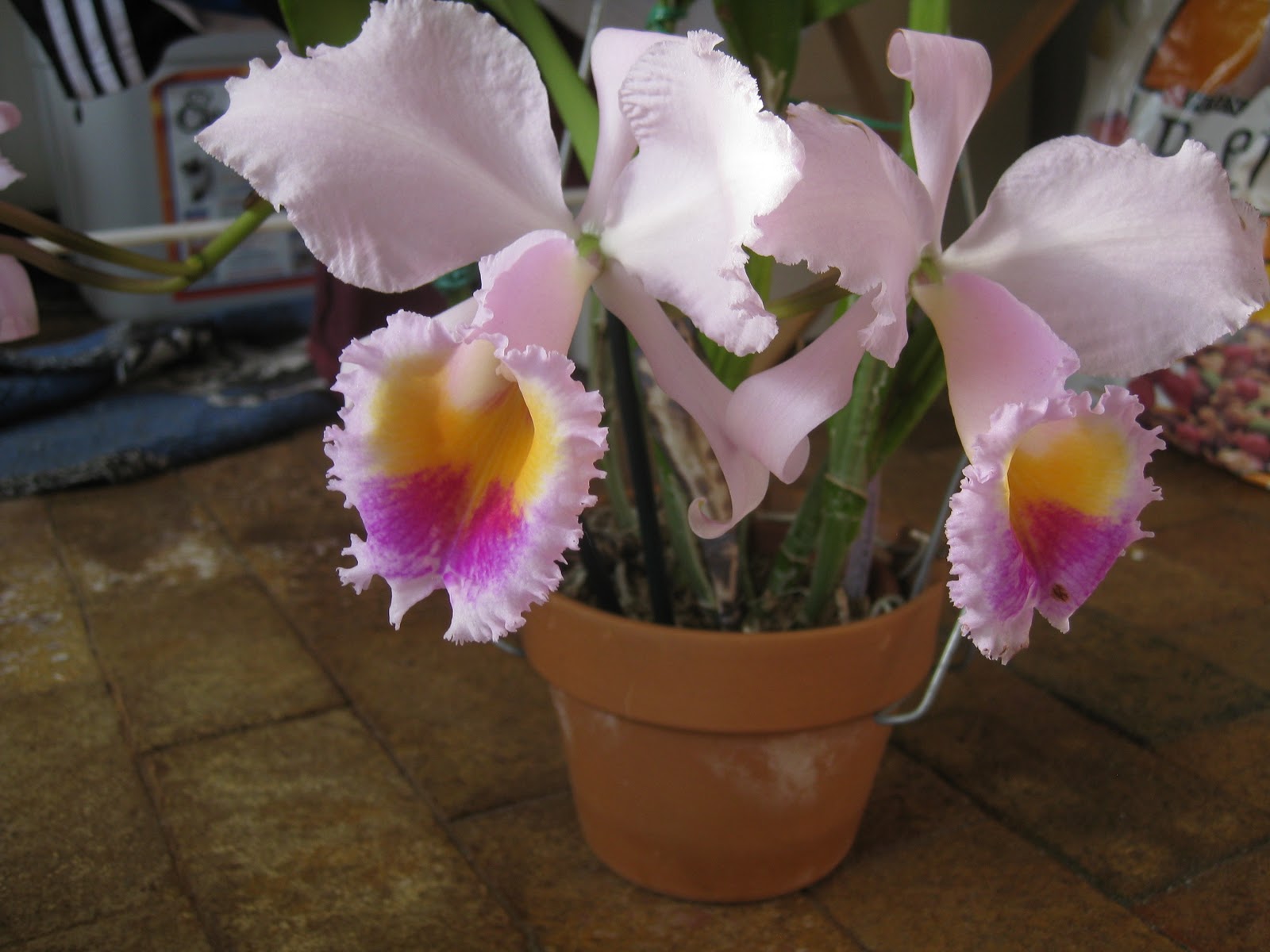
C. skinneri

C. skinneri

This is one of my favorite plants in my entire collection. It was a gift from a very experienced grower in the orchid society. The year before he gave it to me he had a specimen of ‘Debbie” that was a show stopper, or at least a show table stopper. It had 8-10 bloom spikes and 12 or so flowers on each. The next year he had divided it and had a large piece in flower on the show table and donated a smaller piece in bud to the society for auction. I bid on it, but in the end it was just to rich for my blood at the time. To my surprise at the next meeting he brought me a piece. I have enjoyed it ever since.


I follow the culture recommendations of the Chadwick’s. They go something like this, “In the United States, C. skinneri normally begins sending out new growths in late summer and will complete these by late autumn or early winter. If you encourage the plant to begin growing a little earlier with frequent light sprays of water in late June, it can make two growths a season and bloom on both of them.

Once a growth is mature, the sheath will turn brown and buds will develop and emerge from the dried brown sheath in time for it to flower in late March into mid-April. The flowers will last in bloom three to four weeks under normal home conditions — a little longer at cooler temperatures of 55 to 60 F (13–16 C). After blooming, the plant should receive less water and be allowed to rest for a couple of months.
Like most Cattleya species, C. skinneri needs lots of sun and moving air. A night temperature of 58 to 60 F (14–16 C), and a day temperature of 85 F (29 C) suits it well.
Repot C. skinneri immediately after it has finished flowering. If you want to develop an exhibition plant with many growths and flowers, instead of cutting it up and repotting it, simply move the plant into a larger-size pot as soon as the lead pseudobulb reaches the edge of the container. You should do this before the lead pseudobulb begins to root.”

I plan to let this plant grow into a specimen and will repot it when it is done flowering. Which now, by the time I have gotten around to posting this has been done…. I almost skipped posting this, because by the time I took the pictures the flowers were starting to fade. Not by best work.

Monday, April 18, 2011

NOID Phal’s

NOID Phal’s

Despite the fact that I don’t particularly care for phalaenopsis, I seem to have a bunch of them. There was a time when I would see a nice one out a store and pick it up, but I have not paid for one in years. All the same, they seem to multiply. People will bring me a sad, half dead plant and ask if I can try to heal it for them. I have learned that this is a euphemism ‘take it off my hands’. Even when they are healthy and in bloom, it is difficult to get the former owner to reclaim them. And so they the live with me. There are several in bloom now. They are nice looking and the look good around house, but the truth is I just don’t have a deep love for them…. And sadly, I would guess there will be more around the growing as I am just not able to say no to a free plant……


Friday, April 15, 2011

C. mossiae semi alba

C. mossiae semi alba

One of my favorite parts of spring is the blooming of my C. mossiae semi alba. I bought this plant out of bloom a few years ago from the fine folks at Chadwick and Son Orchids. When I bought it, I was hungry for plants, and adding things to my collection at a frantic pace. But in this instance it worked out well.

I find mossiae to be an easy plant to grow, as long as you understand its culture.  My mossiae does not finish its new growth until late fall when it then sends out new roots from the growth. I have found this is the time to repot it and still get a nice bloom in the spring.


Thursday, April 14, 2011

C. aurantiaca

C. aurantiaca

This is a first bloom seedling for me and I am very happy with it. It came from Al’s Orchid Greenhouse, an orchid shop that I have only been to once but really enjoyed. They had a ton of stock and a very diverse selection.

C. aurantiaca has wonderful color and nice little flowers. Mature plants have bloom spikes with 12 or more flowers and make nice specimen plants. They are available in a wide range of color, but by far orange seems to be the most common.  The species tends to have a flower form that does not open fully compared with many other cattleya. But this plant seems to have a nice open flower and a nice lip. I hope that as the plant matures the flower will do even better.

For me cattleya are an addiction, and seeing this plant in bloom makes me want to acquire the other color forms. C. aurantiaca has some very nice yellow, red and even alba forms. These color forms are often for sale as seedling plants on ebay, but I never trust that they will have they flower type I am looking for in my collection. These days as space is a premium in the growing area, I am seeking quality in my plants as apposed to quantity, and I am forced to restrain myself. But it is always fun to window shop….


Wednesday, April 13, 2011

C. lueddemanniana

C. lueddemanniana

Sad to say my work has kept me away from the blog for to long. But on the plus side my plants have been having a good spring. In particular my C. lueddemanniana has done very well. It put on quite a show. It gave me 13 huge flowers all in bloom at the same time. I have a particular love for this plant because it was the first species cattleya that I had in the collection. Thus far it has never let me down. I have found that C. lueddemanniana loves sun, the more I give it in the summer, the better the bloom will be in the spring. When the plants are in the shade tent over the summer, this plant is in a position that get full, unfiltered morning sun and then only 30% shade in the afternoon. I have found that as long as the plant stays cool, it will take all the sun you can give it. My only complaint with C. lueddemanniana is that, the bloom is short lived. Mine stays in bloom maybe 14 days then fades away again for another year. I have added several seedling crosses of C. lueddemanniana from Sunset Valley Orchids recently. I look forward to seeing what they have to offer as they grow.


Friday, March 4, 2011

C. schroederae

Things have been a little slow in my growing area, and very busy at work, and as such the blog has suffered. The Virginia Orchid Society annual show was last week, and thought I did squeak out the time to swing by for an hour, I did not take my camera and I should have. There were many incredible plants and displays. Also, I ended up with a few now plants that perhaps will be the subject of my next post.
But today is about C. schroederae. This plant is more or less typical of the species. Some of the nicer varieties have a softer lip than this one. Historically this plant was confused with C. trianaei, and it shares similar growth habits. A.A. Chadwick explains, “Cattleya schroederae begins growing in the spring when a late C. trianaei would, and its growth matures with C. trianaei in late summer. It then rests for several months, like C. trianaei, before sending up flowers. The pseudobulbs of C. trianaei and C. schroederae look virtually the same, and one can easily be mistaken for the other. The flowers of C. schroederae, like those of C. trianaei, are also among the longest lasting of the Cattleya species (five weeks is normal), and both C. trianaei and C. schroederae are well-known for their clones with fine, round shape.” If you would like the whole story of C. schorederea you can find it here.